

Community financial institutions pride themselves on personalized relationships with their clients. But commercial bankers are assigned more relationships than any one person can reasonably manage, leading to missed opportunities. Loans approaching renewal get refinanced elsewhere before the banker can have the conversation, or customers ready for a larger line of credit turn to a competitor that called first.
Expanding Team Capacity With AI
Financial institutions already hold the data that signals these opportunities; the challenge is combing through thousands of data points daily to find them. That’s where artificial intelligence (AI) comes in — expanding a banker’s capacity to catch what would otherwise slip by.
AI can monitor every relationship at once and surface the ones that need attention today. Bankers spend their limited time on the relationships that matter most instead of hunting for them, moving from reactive to proactive. Meanwhile, those who have not yet embraced AI wait for the customer to call and may miss out on valuable opportunities.
Why It’s Not That Simple for Banks
While AI shows great promise for enhancing relationships, adoption is harder for financial institutions, which run into three major issues:
- Cost. The most powerful AI models are overkill for everyday work. A bank doesn’t need the largest, most expensive model on the market to classify a transaction or route a service request. Using one for simple tasks is like dispatching a corporate jet to pick up the mail; it works, but it burns money better spent serving customers.
- Scale. Even as new data centers come online, demand for the most advanced AI is outpacing supply, so that capacity stays limited and expensive. As a bank rolls out AI across more of the business, those costs can climb quickly.
- Compliance. Most off-the-shelf AI doesn’t understand the institution it serves. It returns answers that sound correct but may not match the bank’s own reports. It may answer differently depending on who asks and often can’t show how it reached a conclusion, which is a problem when examiners expect every decision to be explainable.
The Solution: An Intelligence Layer
Since the most advanced AI is costly and lacks the institutional knowledge and transparency regulators expect, forward-looking banks and credit unions now reserve those powerful models for the tasks that truly need them.The solution for addressing other tasks is an intelligence layer — an architecture that sits between business systems and the model landscape. It does five things:
- Routes each request to the right level of intelligence. Every task is matched to the appropriate tool, whether a top-tier model, a specialized one, or a simple rule, so the bank never pays for more processing power than the job needs.
- Enforces the bank’s policies before any data moves. Access rules, data handling and audit trails are applied up front, so compliance requirements are met every time.
- Supplies only the data each request needs, without exposing the rest of the institution’s records.
- Manages complex, multistep work so a single business task remains one coordinated process instead of a tangle of disconnected requests.
- Tracks every decision and its cost, turning AI from a black box into a transparent system the bank can measure and improve over time.
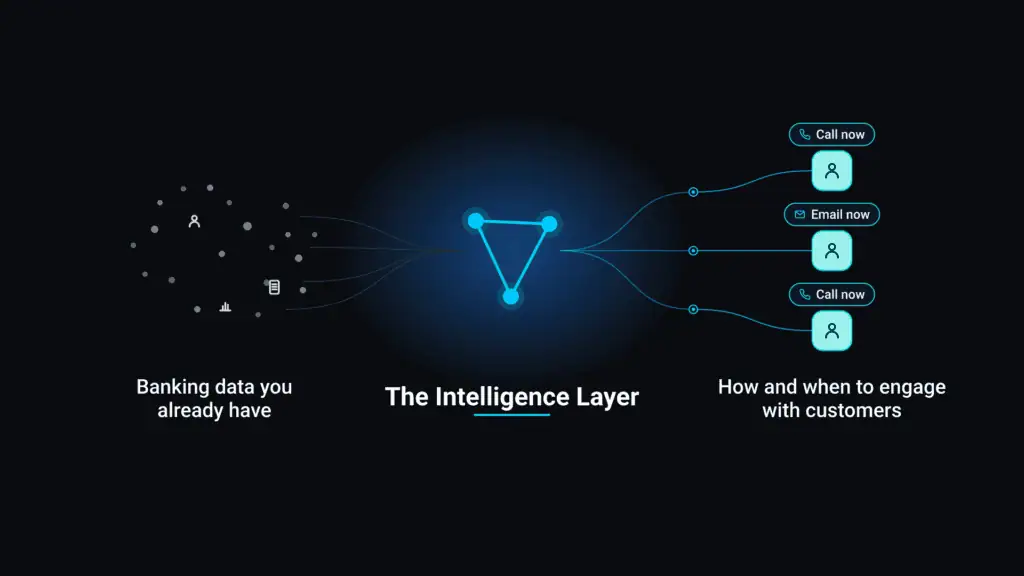
By embedding the bank’s own business logic and context, the intelligence layer puts the institution back in control of its AI — what it costs, where it is used and whether it meets the standards examiners and leadership expect. It answers the questions every bank is starting to ask about cost, value, compliance and resilience, all while keeping the focus on building relationships.
What’s Next?
Financial institutions that adopt this approach spend less on AI, clear compliance reviews faster and get better results from the work that genuinely needs advanced AI, because that capacity is no longer tied up handling routine requests.
Leadership also gains something it can stand behind with regulators and the board: a documented, well-governed approach to AI built on a single coordinated system.
For the institutions that move first, the payoff goes beyond lower costs and easier compliance. Their bankers are freed to do what drew customers to a community bank or credit union in the first place: build genuine relationships at a scale that finally keeps pace with the business.







 Previous