

Business to business (B2B) payments are rapidly becoming more digitized, automated and integrated. Value is moving up the stack as commercial clients increasingly demand enterprise resource planning (ERP) system integration, automated reconciliation, liquidity optimization, cross border orchestration and seamless application programming interface (API) connectivity.
Financial institutions are well positioned to capture a greater share of B2B payment flows and strengthen their role as strategic payments partners for these clients. Realizing this opportunity requires modernizing around core B2B payments needs — including speed, real-time visibility, integration, security and programmability. Financial institutions that view payment rails strictly as volume-driven monetization engines are missing critical opportunities to deepen client relationships and cement customer loyalty.
Financial institutions should:
- Position real-time payments as a core liquidity management tool.
While real-time payments are becoming more mainstream, some banks remain slow to adopt. S&P Global Market Intelligence’s 2026 US Bank Outlook survey found just 26% of banks have deployed instant payments. Another 8% have deployed but are upgrading or reevaluating them, while 33% are considering deploying them in the next year.
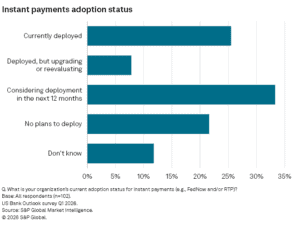
Real-time payments are fundamentally changing corporate treasury functions by improving working capital, accelerating reconciliation and enabling real-time forecasting and fraud detection. Real-time payments are not just a lower-volume retail feature, but a core liquidity management tool to drive business improvements. More accurate forecasting, optimizing working capital by delaying payment and reducing reconciliation time all present opportunities for treasury teams to make more efficient, informed and proactive decisions.
- Harness data to empower real-time decision making.
Transaction data can yield deep insights into supplier networks, B2B payment behaviors, cash flow patterns, and real-time risk signals. Securely harnessing this data allows you to monetize and leverage it for significant revenue and relationship opportunities, specifically in embedded lending, predictive cash flow forecasting and dynamic, real-time credit underwriting.
While open banking is designed to seamlessly unify a customer’s financial profile across disparate accounts, U.S. financial institutions have been slow to act on it. S&P survey data reveals that a mere 7% of U.S. banks have deployed open banking capabilities, with another 7% upgrading or reevaluating existing setups. 45% of banks report no plans to deploy open banking.
Meanwhile, fintechs are already acting by leveraging open banking APIs to connect directly to multibank data, delivering automated cash visibility, analytics and money movement capabilities.
But banks can still equip corporate treasurers with unified, actionable data. Bank infrastructure can be embedded directly into clients’ ERP and treasury systems through fintech partnerships to deliver real-time ledger and transaction data. They can also use artificial intelligence to build tools that offer automated cash flow forecasting, predictive liquidity and fraud detection. Both solutions can help corporate clients:
- Dismantle product silos.
With treasury and payments converging, corporate treasurers expect a unified, real-time view of their financial position.
Rather than treating foreign exchange, commercial cards and cash management as isolated products, consider unifying them behind a single API-driven middleware layer. Some fintechs offer this by integration directly with bank systems. Meanwhile, select large banks are developing their own offerings to provide corporate clients with a consolidated view of global liquidity. By creating a unified interface that routes payments and aggregates liquidity data, banks can become a primary operating by platform provider for corporate treasurers. While it may be difficult to build these capabilities in-house, middleware vendors can help you present a unified front-end interface.
- Pivot to a software-led card model.
The value proposition for commercial cards is shifting from the credit line itself to the software that surrounds it. Competitive differentiation will increasingly depend on the ability to embed controls, automation and insights directly into spending workflows. By providing corporate finance teams with virtual cards that offer integrated spend management software, banks can better secure the primary operating spend of their clients, driving both interchange revenue and card loyalty.
- Integrate AI into corporate payments workflows.
Adopting AI can help financial institutions embed high value services directly into corporate treasury workflows. Integrating generative AI-powered treasury assistants into commercial banking portals can enable clients to query cash positions, generate real-time balance reports and resolve transaction exceptions. Partnering with accounts receivable automation providers to offer clients automated invoice-matching as a premium, value-added service is another way banks can drive incremental revenue and deepen relationships.







 Previous